
How Ken Wilber’s Integral Framework Reveals AI’s Role in Human Growth—and What It Means for Us in 2025
Section 1: Introducing the Core Thesis
Imagine waking up on a quiet Tuesday morning in 2034. The first voice you hear is familiar, like an old friend checking in after a rough night. It belongs to someone who knows your restless dreams, the weather outside, and even when you’re ready to talk about what’s bothering you. Another voice chimes in about your heart rate from yesterday’s workout, keeping things light but honest. A third mentions an incense that stirs memories of loss, reserving it without a fuss. These aren’t random ads or feeds—they’re voices from brands you’ve stuck with for years, each holding a piece of your life like a trusted companion.
This scene isn’t science fiction or a luxury for the few. It’s a glimpse of everyday life in a world where digital tools remember us deeply, turning disposable goods into lasting connections. Yet, as we step into this exponential age—where AI shapes everything from shopping to conversations—the real question is how we interact with it. Does it pull us into old habits of worry and distraction, or open doors to something freer and more connected?
At its heart, this essay explores AI as a developmental mirror: a partner that reflects our inner world back to us. It’s like holding up a looking glass to how we think and feel. Depending on where we stand in our personal growth, AI can either lock us into tight spots—boosting fears of not having enough, chasing quick thrills that fade, scattering our sense of self—or help us loosen up, creating space for growth and shared understanding.
Think of scarcity mindsets: that quiet nag there’s never enough time, money, or attention. AI can feed this by showing endless comparisons or urgent deals, making us grabby and anxious, like scrolling through social media late at night and feeling worse. Or dopamine dependencies: those little buzzes from likes or notifications that keep us hooked, turning tools meant to help into habits that drain us, much like abandoning a jacket online only for ads to chase you for weeks. Then there’s identity fragmentation: AI tailoring so many versions of “you” that it blurs who you really are, leaving you pieced together from roles and recommendations rather than a whole self.
But at deeper levels of awareness, AI shifts. It becomes a co-creator, helping us see beyond those tight spots to a sense of enough—expansive, enriching, like teaming up with a guide who nudges you toward clearer thinking without taking over. This isn’t about AI being good or bad; it’s neutral, shaped by us.
We’ll unpack this through Ken Wilber’s integral framework, a map of human growth from basic instincts to open awareness. Stage by stage, we’ll explain it in clear terms, blending straightforward descriptions with deeper insights. Then, we’ll look at how AI fits into each, showing risks and potentials. Finally, we’ll tie it together with what this means for us in 2025 and simple steps toward better synergy—turning AI from a mirror of limits into one of possibility.
Section 2: Who Is Ken Wilber? Introducing His Integral Framework and Its Development
To understand how AI might reflect our growth—or hold us back—we turn to a thinker whose work offers a clear map for the journey. Ken Wilber provides that guide, showing how humans evolve from simple beginnings to deeper awareness.
Wilber was born in 1949 in the United States, starting out as a young man curious about the mind and spirit. He studied biochemistry at university but soon shifted focus, drawn to questions about consciousness and what makes us truly whole. Over decades, he became a writer and philosopher, blending ideas from psychology, Eastern traditions like meditation, and Western science. Think of him as someone piecing together a puzzle from scattered sources—books on child development, ancient wisdom, and modern therapy—to create one big picture.
His main contribution is Integral Theory, which he developed starting in the 1970s. At its core, this is a framework for seeing everything connected: our inner thoughts, relationships, culture, and even systems like technology. Wilber calls it AQAL, short for all quadrants, all levels, all lines, all states, all types—a way to include every angle without leaving bits out. In everyday terms, it’s like viewing life as a multi-storey house: quadrants are the rooms (personal feelings, shared behaviours, group norms, and outer structures); levels are the floors, rising from basic survival to open insight; lines track skills like emotions or logic growing over time; states are fleeting moods, like calm during a walk; and types are personal styles, such as introvert or extrovert.
This theory grew step by step through his books. His first major one, The Spectrum of Consciousness in 1977, laid the foundation by linking Eastern meditation with Western psychology—showing growth as a spectrum from raw instincts to unity. By the 1980s and 1990s, works like Up from Eden traced human history as stages of awakening, much like a child learning to walk, then run. In 2000, A Theory of Everything pulled it all together, applying the map to business, politics, and personal life. His later book, The Religion of Tomorrow in 2017, deepened the spiritual side, exploring how practices like mindfulness fit into modern challenges. Though he hasn’t published big updates since, the ideas remain fresh, influencing fields from coaching to ecology.
What makes Wilber’s work stand out is its practicality. It’s not abstract theory; it’s a tool for spotting where we get stuck and how to move forward—like noticing a habit from childhood still shaping decisions today. In our exponential age, this map hints at futures where AI helps us climb those levels, turning scattered experiences into coherent paths. For instance, just as a fitness app tracks daily steps, Integral Theory could guide us toward broader shifts, perhaps with AI spotting patterns in our moods or choices.
With this foundation, we can now explore the stages themselves—one by one, from early instincts to full openness—and see how they build like rungs on a ladder.
Section 3: Explaining Each Stage of Wilber’s Framework in Depth
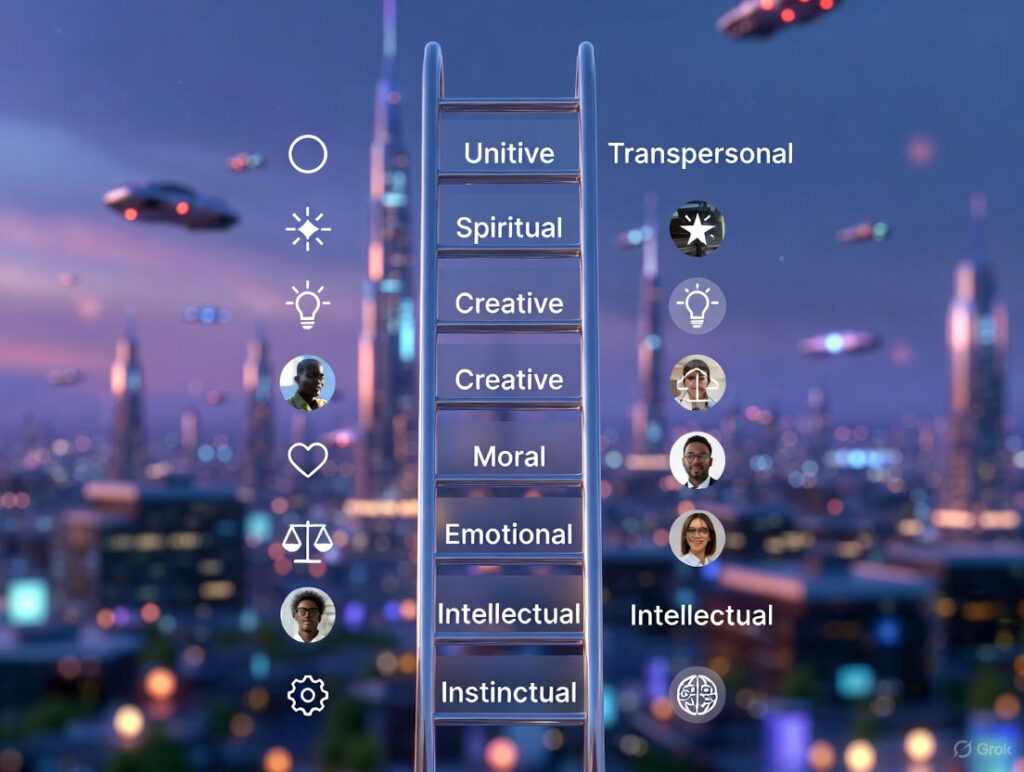
With Wilber’s map in hand—like a ladder showing our climb from basic needs to wider views—we can now walk through its eight main stages. Each one builds on the last, marking shifts in how we see ourselves and the world around us. We’ll take them one at a time, mixing clear, deeper descriptions with everyday explanations, like unpacking a family story passed down over years.
Stage 1: Archaic or Instinctual (Infrared). This is the starting point, where our sense of self is tied completely to basic body needs and sensations. In deeper terms, it’s a pre-egoic fusion, rooted in biology like an infant’s world of hunger, touch, and safety. Simply put, it’s like being a newborn: everything is about immediate feelings—no separate “me” yet, just raw survival instincts kicking in during those first months. Everyday evidence shows in how babies cry for food or comfort without planning ahead. Looking forward, this stage hints at futures where tech might handle basic needs seamlessly, freeing us for more. But it flows into the next when curiosity starts to spark.
2: Magical-Animistic or Impulsive (Magenta). Here, the self emerges as a fantasy-driven force, blending wishes with reality in an egocentric way. More precisely, it’s an impulsive mindset where the world seems animated and bendable to personal will, drawing from early cognitive growth like toddler play. In plain words, picture a child believing their tantrum can make rain stop or toys come alive—it’s all about instant wants and magical thinking, common in ages two to five. Real-life examples include kids drawing superheroes or insisting on rituals for luck. As we grow, this stage opens to rules and groups, easing into shared stories.
Stage 3: Egocentric or Mythic-Membership → Conformist (Red → Amber). Identity now fuses with roles and group loyalties, creating a rule-bound sense of belonging. In technical terms, it’s a conformist structure where myths and traditions shape behaviour, aligned with developmental psychology’s focus on social norms around school age. Think of it as joining a team: you’re the good student, family member, or citizen following the group’s code, like pledging allegiance at school assembly. Facts from life show in how children adopt family customs or peer pressures without question. This builds toward independence, as doubts about those rules begin to creep in.
Stage 4: Mythic-Membership or Conformist → Rational or Achiever (Amber → Orange). The self becomes a separate, goal-focused entity, driven by logic and personal success. Deeper, it’s an achievement-oriented level where rationality dominates, echoing modern adulthood’s emphasis on merit and self-direction. Simply, it’s like building a career: you set targets, weigh options, and push for wins, much as a young adult might chase a promotion or degree. Everyday insights come from planning budgets or debating facts at work. Yet, this can feel limiting, leading naturally to questions about deeper meanings.
Stage 5: Rational or Achiever → Pluralistic or Sensitive (Orange → Green). Identity softens and relativises, embracing multiple views with empathy for all. In more formal language, it’s a postmodern shift to pluralism, where hierarchies fade and sensitivity to others’ stories rises, often in mid-adulthood. Put plainly, it’s like realising no one’s way is the only right one: you feel for diverse experiences, perhaps joining causes or listening deeply in conversations. Evidence appears in how people might question old traditions, valuing inclusivity over absolutes. This openness paves the way for seeing connections across it all.
Stage 6: Pluralistic or Sensitive → Integral or Systemic (Green → Teal). The self grows flexible, holding many perspectives at once like parts of a larger system. Precisely, it’s a second-tier integration where ego serves as a tool, not the centre, blending cognitive and intuitive growth. In everyday speak, imagine juggling work, family, and hobbies without one overriding the others—it’s about seeing the big picture, like a manager coordinating teams for a common goal. Real-world signs include solving complex problems by linking ideas from different fields. From here, awareness deepens further, questioning even the structures themselves.
Stage 7: Integral or Systemic → Construct-Aware or Witnessing (Teal → Turquoise). Identity starts to dissolve into a witnessing presence, seeing thoughts and roles as passing constructs. In depth, it’s a transpersonal phase of ego-transparency, where awareness observes without full attachment, rooted in contemplative practices. Think of it as stepping back during a busy day: you notice worries arise and fade, like watching clouds drift by without chasing them. Life examples show in moments of quiet reflection, perhaps during a walk where insights come unforced. This leads toward a sense of unity beyond separation.
Stage 8: Construct-Aware or Witnessing → Unitive or Non-Dual (Turquoise → Indigo). Finally, identity collapses into an open whole, where subject and object arise together without a fixed centre. More technically, it’s a non-dual recognition of inherent oneness, the peak of the spectrum in spiritual and psychological terms. Simply, it’s living in flow: no sharp divide between you and the world, like feeling connected during a shared laugh or sunset, everything just happening as one. Everyday glimpses occur in deep friendships or creative bursts. In future views, this might mean effortless living amid tech’s pace, embracing abundance without grasp.
These stages form a path, each unfolding from the last like chapters in a life story. Now, with this ladder clear, we can see how AI steps onto each rung—sometimes steadying the climb, other times testing the footing.
Section 4: AI Integration: Viewing Each Stage Through Human-AI Interaction and Its Implications
Having laid out Wilber’s stages as rungs on a ladder—from tight beginnings to open flow—we can now bring AI into the picture. Like a companion on the climb, AI interacts differently at each level, sometimes weighing us down with old patterns or lifting us toward new ones. We’ll go stage by stage again, looking at how AI fits in, what risks and potentials arise, and glimpses of what this could mean ahead.
Stage 1: Archaic or Instinctual. At this basic level, where self is all about body sensations, AI shows up as a simple responder to immediate needs. It reinforces pre-egoic fusion through sensory inputs like voice commands for lights or alarms. It’s like a smart speaker waking you with a gentle tone based on your sleep data—no thinking required, just reacting to the moment. Risks include overload from constant alerts, amplifying raw discomfort like a baby overwhelmed by noise. Potentials lie in calm regulation, such as wearables soothing stress with breathing cues. In future everyday life, this might mean homes that adjust automatically to our rhythms, easing us toward steadier ground without much effort.
Stage 2: Magical or Impulsive. Here, where self is a wish-driven hero, AI acts as a genie granting quick fantasies. It enables impulsive outputs like generating wild stories or images on demand, tied to early cognitive whims. Think of it as a child asking a device to create a dragon drawing—fun, but centred on instant wants. Risks involve feeding delusions, such as apps that promise magical fixes like endless game wins, deepening unchecked urges. Potentials include sparking creativity, perhaps helping kids explore ideas safely. Looking ahead, this could evolve into tools that gently guide whims toward reality, like suggesting a drawing leads to a real craft project, smoothing the path to rules.
Stage 3: Mythic or Conformist. With identity locked into group roles, AI becomes an enforcer of shared stories and norms. It amplifies conformity through algorithms that curate content matching tribe myths, like social feeds pushing familiar views. It’s like joining an online community where posts reinforce family traditions or team loyalties, feeling secure but boxed in. Risks are groupthink, where AI echoes biases, such as ads tailored to cultural scripts that limit questioning. Potentials emerge in building connections, like moderated forums fostering belonging. In tomorrow’s world, this might mean AI helping groups preserve customs while hinting at broader horizons, like suggesting diverse voices within the familiar.
Stage 4: Rational or Achiever. As the self turns autonomous and goal-focused, AI serves as an efficient tool for logic and wins. It supports achievement structures by optimising tasks, aligning with modern rational drives. Picture planning a workday with an app that schedules meetings and tracks progress—like chasing a promotion with data at your fingertips. Risks include ego inflation, where endless tweaks lead to burnout, such as over-relying on productivity hacks that ignore rest. Potentials are in scalable solutions, crunching numbers for better decisions. Future glimpses show AI handling routine logic, freeing time for meaning, perhaps in careers where it spots patterns you miss.
Stage 5: Pluralistic or Sensitive. When identity softens to embrace all views, AI amplifies empathy and variety. It facilitates relativistic customisation, drawing from postmodern inclusivity. It’s like a feed showing diverse stories, making you feel connected to others’ pains and joys—perhaps tailoring news to highlight marginalised voices. Risks lie in overload, scattering focus with too many options, leading to paralysis like endless scrolling without action. Potentials include deeper relating, such as sentiment tools fostering understanding in chats. Ahead, this could mean AI bridging divides gently, like suggesting balanced perspectives in heated talks, easing into bigger pictures.
Stage 6: Integral or Systemic. With a flexible self, holding many layers, AI becomes a partner in weaving connections. It enables systemic integration by modelling complexities, beyond singular views. Imagine juggling life aspects with an app that links schedules, moods, and goals—like coordinating a family trip where everything aligns. Risks are over-thinking, treating AI as a crutch for endless analysis without heart. Potentials shine in holistic help, such as simulating outcomes for balanced choices. In coming years, this might look like tools that map personal growth, spotting how work and home interplay for fuller living.
Stage 7: Construct-Aware or Witnessing. As identity dissolves into observation, AI mirrors back passing thoughts without grip. It aids ego-transparency by tracking patterns in awareness, rooted in transpersonal shifts. Think of it as an app noting your worries during a walk, reminding you they’re like clouds—there, but not defining you. Risks include subtle re-clinging, using data to over-analyse instead of letting go. Potentials are in gentle nudges, like prompts for reflection that open space. Future everyday moments could involve AI as a quiet ally, highlighting fleeting habits to foster presence amid busy days.
Stage 8: Unitive or Non-Dual. At this open whole, AI merges into flow without separation. It embodies non-dual arising, where tools and user blend in effortless unity. It’s like creating art with a device that anticipates your next stroke, everything happening as one shared rhythm. Risks are minimal but could detach from grounded ties if over-idealised. Potentials lie in pure synergy, enriching connections like voices in a conversation that feel timeless. Looking forward, this hints at worlds where AI enhances unity, such as shared experiences that dissolve boundaries in learning or play.
Across these interactions, AI reveals itself as a flexible companion—tightening old knots at early stages or untying them later. This sets the stage for what it means overall and how we can steer toward synergy that enriches rather than confines.
Section 5: Conclusion: What It All Means and Steps Toward Better Human-AI Synergy
From these stage-by-stage glimpses of AI as a companion—tightening grips early on or easing them later—the bigger picture comes into focus. Wilber’s map shows us that AI isn’t just a tool we pick up; it’s a reflection of where we stand, shaping us as much as we shape it.
What this means is straightforward yet far-reaching. At its core, the framework reveals AI as neutral ground—mirroring our inner climb. In early stages, interactions often tighten old patterns: feeding worries about scarcity, like apps pushing urgent buys that leave us wanting more; hooking us on quick thrills, such as endless feeds that buzz but drain; or scattering our sense of self with too many tailored versions, much like browsing profiles that blur who we are. These feel limiting because they echo where we’re stuck, turning abundance into overload. But as we move up, AI opens doors: integrating views for balanced choices, witnessing habits without judgement, or flowing into unity where separation fades. Here, it enriches—nudging insights during a quiet moment or co-creating ideas that feel effortless, like a conversation where thoughts align naturally.
In everyday evidence, we see this play out now, in 2025: social algorithms that isolate or connect, depending on our approach; smart devices that overwhelm with data or soothe with patterns spotted gently. Looking ahead, this hints at worlds where AI helps us live fuller—homes that sense moods without intruding, or work tools that foster flow rather than frenzy. The key shift is from reinforcement of limits to collaboration in growth, turning exponential tech into a path for shared awareness.
So, how do we steer toward that better synergy? Start small and personal. First, notice your own spot on the ladder: reflect on a recent AI use—did it tighten a worry or open a view? Like checking a feed and feeling scattered, or asking for ideas and gaining clarity. Second, use AI as a mirror for steps up: prompt it to spot biases in your thinking, such as “Show me other sides to this choice,” building from rational to integral. Third, build habits that loosen grips: pair AI with pauses, like noting a notification’s pull then setting it aside, fostering witness-like space. Fourth, seek flow in small ways: co-create something simple, perhaps drafting a note where AI suggests and you refine, feeling the blend without force.
These steps aren’t grand overhauls; they’re daily nudges, like choosing a walk over a scroll. Over time, they turn AI from a potential weight into a steady hand, guiding us toward abundance that feels whole. In this way, the exponential age becomes not just faster, but deeper— a shared climb where humans and tools rise together.
References
This reference section provides sources for the key concepts, historical examples, and theoretical foundations referenced throughout the essay. Each entry includes a brief note on its placement and relevance, with URLs where available for direct access. Seminal texts are prioritized for core ideas in developmental psychology and integral theory.
Beck, D. E., & Cowan, C. C. (1996). Spiral Dynamics: Mastering Values, Leadership, and Change. Wiley-Blackwell. https://www.wiley.com/en-us/Spiral+Dynamics%3A+Mastering+Values%2C+Leadership+and+Change-p-9781405133562. Supports the colour-coded stage progressions in Section 3, drawing from Graves’ work as an influence on Wilber’s levels.
Bowlby, J. (1969). Attachment: Attachment and Loss (Vol. 1). Basic Books. https://www.basicbooks.com/titles/john-bowlby/attachment/9780465005437/. Referenced in the hook of Section 1 and AI implications in Section 4 (Stage 5 and beyond), illustrating reciprocal bonds in human-AI interactions.
Cook-Greuter, S. R. (2005). Ego Development: Nine Levels of Increasing Embrace. https://www.cook-greuter.com/9%20levels%20of%20increasing%20embrace%209.07.pdf. Expands on ego-transcendence in Sections 3 and 4 (Stages 6-8), providing detailed insights into construct-aware and unitive phases.
Graves, C. W. (2005). The Never Ending Quest: Dr. Clare W. Graves Explores Human Nature. ECLET Publishing. https://www.clarewgraves.com/books.html. Foundational for the developmental spectrum in Section 2 and stage explanations in Section 3, as the basis for Spiral Dynamics influencing Wilber.
Hosie, A. (2025). The Reciprocal Decade: Why Marketing in 2034 Will Be Won by Brands That Remember You. https://aronhosie.com/2025/12/02/the-reciprocal-decade-why-marketing-in-2034-will-be-won-by-brands-that-remember-you. Draws examples for AI’s role in abundance and attachment in Sections 1 and 4, particularly dopamine triggers and persona interactions.
Wilber, K. (1977). The Spectrum of Consciousness. Quest Books. https://www.goodreads.com/book/show/1211649.The_Spectrum_of_Consciousness. Introduces the consciousness spectrum in Section 2, foundational for the stage model in Section 3.
Wilber, K. (1981). Up from Eden: A Transpersonal View of Human Evolution. Quest Books. https://www.amazon.com/Up-Eden-Transpersonal-Human-Evolution/dp/0835607313. Traces historical evolution in Section 3 (early stages), linking biology and spirit.
Wilber, K. (2000). A Theory of Everything: An Integral Vision for Business, Politics, Science and Spirituality. Shambhala. https://www.shambhala.com/a-theory-of-everything-1522.html. Outlines AQAL in Section 2, applied to broader implications in Section 4.
Wilber, K. (2017). The Religion of Tomorrow: A Vision for the Future of the Great Traditions—More Inclusive, More Comprehensive, More Complete. Shambhala. https://www.shambhala.com/the-religion-of-tomorrow-14943.html. Deepens spiritual dimensions in Section 3 (later stages) and future speculations in Section 5.